SHC-Transforming Protein 3 (SHC3) Antibody
221€ (50 µg)
Por favor contáctenos para obtener información detallada sobre el precio y disponibilidad.
Name
SHC-Transforming Protein 3 (SHC3) Antibody
Category
Primary Antibodies
Provider
Abbexa
Reference
abx326455
Tested Applications
ELISA, IHC
Description
SHC3 Antibody is a Rabbit Polyclonal against SHC3.
Documentos del producto
Instrucciones
Data sheet
Especificaciones del producto
| Category | Primary Antibodies |
| Immunogen Target | Target: SHC-Transforming Protein 3 (SHC3) Immunogen: Synthesized peptide derived from the Internal region of human N-Shc. |
| Host | Rabbit |
| Reactivity | Human, Mouse, Rat |
| Recommended Dilution | ELISA: 1/10000, IHC: 1/100 - 1/300. Optimal dilutions/concentrations should be determined by the end user. |
| Clonality | Polyclonal |
| Conjugation | Unconjugated |
| Isotype | IgG |
| Purification | Purified by affinity chromatography. |
| Size 1 | 50 µg |
| Size 2 | 100 µg |
| Form | Liquid |
| Tested Applications | ELISA, IHC |
| Buffer | PBS containing 50% glycerol, 0.5% BSA and 0.02% sodium azide. |
| Availability | Shipped within 5-10 working days. |
| Storage | Aliquot and store at -20°C. Avoid repeated freeze/thaw cycles. |
| Dry Ice | No |
| UniProt ID | Q92529 |
| Gene ID | 53358 |
| Alias | N-Shc,NSHC,RAI,SHCC,Neuronal Shc,SHC-transforming protein C,SHC-transforming protein 3 |
| Background | Antibody anti-SHC3 |
| Status | RUO |
| Note | THIS PRODUCT IS FOR RESEARCH USE ONLY. NOT FOR USE IN DIAGNOSTIC, THERAPEUTIC OR COSMETIC PROCEDURES. NOT FOR HUMAN OR ANIMAL CONSUMPTION. |
Background
SHC3, also known as N-Shc, is a neuron-specific adaptor protein involved in neurotrophin signaling and neuronal development. It shares structural similarities with SHC1 and SHC2, containing PTB and SH2 domains that mediate interactions with phosphorylated receptor tyrosine kinases, including Trk receptors. SHC3 specifically activates pathways such as Ras/MAPK, PI3K/Akt, and ERK, promoting neuronal survival, differentiation, and axonal growth. It is highly expressed in the developing and adult nervous system, where it regulates synaptic plasticity, neuronal connectivity, and brain function. Dysregulation of SHC3 has been linked to neurodevelopmental disorders, neurodegeneration, and certain brain cancers, where aberrant activation of signaling pathways affects neuronal survival and proliferation. Knockout studies reveal impaired neurotrophin signaling, reduced axonal outgrowth, and defects in synaptic connectivity, underscoring its critical role in brain development, neuronal maintenance, and signal transduction in the central nervous system.
Productos relacionados
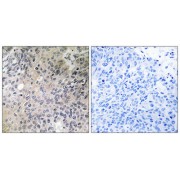
SHC-Transforming Protein 3 (SHC3) Antibody
Rabbit polyclonal antibody against SHC3 protein. Immunogen region is Internal.…
Ver producto SHC-Transforming Protein 3 (Shc3) Antibody
Shc (Src Homology 2 Domain Containing) Transforming Protein 3 Antibody is a Rabbit Polyclonal antibody against Shc (Src …
Ver producto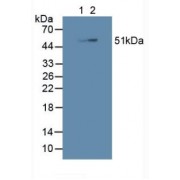
SHC-Transforming Protein 3 (SHC3) Antibody
SHC-Transforming Protein 3 Antibody is a Rabbit Polyclonal against SHC-Transforming Protein 3.…
Ver producto