Human Leukocyte Associated Immunoglobulin Like Receptor 2 (LAIR2) Protein
195€ (10 µg)
Por favor contáctenos para obtener información detallada sobre el precio y disponibilidad.
Name
Human Leukocyte Associated Immunoglobulin Like Receptor 2 (LAIR2) Protein
Category
Proteins and Peptides
Provider
Abbexa
Reference
abx067774
Tested Applications
WB, SDS-PAGE
Description
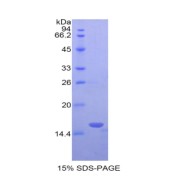
Human Leukocyte Associated Immunoglobulin Like Receptor 2 (LAIR2) is a recombinant Human protein expressed in E. coli.
Documentos del producto
Instrucciones
Data sheet
Especificaciones del producto
| Category | Proteins and Peptides |
| Immunogen Target | Leukocyte Associated Immunoglobulin Like Receptor 2 (LAIR2) |
| Host | E. coli |
| Assay Type | Activity: Not tested Sequence Fragment: Thr21-Pro152 Tag: N-terminal His tag |
| Origin | Human |
| Conjugation | Unconjugated |
| Observed MW | Calculated MW: 15.7 kDa |
| Expression | Recombinant |
| Purity | > 95% |
| Size 1 | 10 µg |
| Size 2 | 50 µg |
| Size 3 | 100 µg |
| Size 4 | 200 µg |
| Size 5 | 500 µg |
| Form | Lyophilized |
| Tested Applications | WB, SDS-PAGE |
| Buffer | Prior to lyophilization: PBS, pH 7.4, containing 0.01% Sarcosyl, 1 mM DTT, 5% Trehalose and Proclin-300. |
| Availability | Shipped within 5-7 working days. |
| Storage | Store lyophilized form at 2-8°C for up to 1 month. For longer periods, store lyophilized or liquid at -80°C. Avoid repeated freeze–thaw cycles. |
| Dry Ice | No |
| UniProt ID | Q6ISS4 |
| Alias | Leukocyte-associated immunoglobulin-like receptor 2,CD306,LAIR-2 |
| Background | Protein LAIR2 |
| Status | RUO |
| Note | THIS PRODUCT IS FOR RESEARCH USE ONLY. NOT FOR USE IN DIAGNOSTIC, THERAPEUTIC OR COSMETIC PROCEDURES. NOT FOR HUMAN OR ANIMAL CONSUMPTION. To keep the original salt concentration, we recommend reconstituting to the original concentration prior to lyophilization (see Concentration) in ddH2O. If a lower concentration is required, dilute in PBS, pH 7.4. If a higher concentration is required, the product can be reconstituted directly in PBS, pH 7.4, though please note that this will change the overall salt concentration. The stock concentration should be between 0.1-1.0 mg/ml. Do not vortex. Concentration: Prior to lyophilization: 200 µg/ml |
Background
Leukocyte Associated Immunoglobulin-Like Receptor 2 (LAIR2) is a soluble immunoregulatory protein belonging to the immunoglobulin superfamily. LAIR2 functions primarily as a natural inhibitor of immune activation by competing with its membrane-bound counterpart, LAIR1, for binding to collagens present in the extracellular matrix. This competitive binding prevents LAIR1-mediated inhibitory signaling on immune cells such as T cells, natural killer (NK) cells, and dendritic cells, which are crucial for maintaining immune homeostasis and preventing excessive immune activation. LAIR2 is expressed predominantly in immune-related tissues, including the spleen, bone marrow, and lymph nodes, and its soluble nature allows it to circulate freely in the bloodstream, acting as a systemic modulator of collagen-induced immunosuppression. Dysregulated LAIR2 expression has been implicated in various pathological conditions, such as autoimmune diseases, where its elevated levels may counteract excessive immune inhibition, or in cancers, where it could interfere with tumor-induced immunosuppressive microenvironments. Therapeutically, LAIR2 has shown promise as a biomarker for immune dysregulation and as a potential agent in immunotherapy strategies aimed at mitigating immune suppression in cancers or promoting immune tolerance in autoimmune disorders. Its precise role and interactions with other immune checkpoints continue to be a subject of active research, with a focus on leveraging its properties for clinical applications in immune modulation.
Productos relacionados
Human Leukocyte Associated Immunoglobulin Like Receptor 2 (LAIR2) Protein
Human Leukocyte Associated Immunoglobulin Like Receptor 2 (LAIR2) is a recombinant Human protein expressed in E. coli.…
Ver producto
Leukocyte Associated Immunoglobulin Like Receptor 2 (LAIR2) Antibody
Polyclonal Antibody to Leukocyte Associated Immunoglobulin Like Receptor 2 (LAIR2).…
Ver producto
Human Leukocyte Associated Immunoglobulin Like Receptor 2 (LAIR2) ELISA Kit
Human Leukocyte Associated Immunoglobulin Like Receptor 2 (LAIR2) ELISA Kit is an ELISA Kit for the in vitro quantitativ…
Ver producto