Mouse KH Domain Containing, RNA Binding, Signal Transduction Associated Protein 1 (KHDRBS1) Protein
234€ (10 µg)
Por favor contáctenos para obtener información detallada sobre el precio y disponibilidad.
Name
Mouse KH Domain Containing, RNA Binding, Signal Transduction Associated Protein 1 (KHDRBS1) Protein
Category
Proteins and Peptides
Provider
Abbexa
Reference
abx067639
Tested Applications
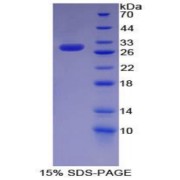
WB, SDS-PAGE
Description
Mouse KH Domain Containing, RNA Binding, Signal Transduction Associated Protein 1 (KHDRBS1) is a recombinant Mouse protein expressed in E. coli.
Documentos del producto
Instrucciones
Data sheet
Especificaciones del producto
| Category | Proteins and Peptides |
| Immunogen Target | KH Domain Containing, RNA Binding, Signal Transduction Associated Protein 1 (KHDRBS1) |
| Host | E. coli |
| Assay Type | Activity: Not tested Sequence Fragment: Leu156-Glu381 Tag: N-terminal His tag |
| Origin | Mouse |
| Conjugation | Unconjugated |
| Observed MW | Calculated MW: 28.2 kDa |
| Expression | Recombinant |
| Purity | > 95% |
| Size 1 | 10 µg |
| Size 2 | 50 µg |
| Size 3 | 100 µg |
| Size 4 | 200 µg |
| Size 5 | 500 µg |
| Form | Lyophilized |
| Tested Applications | WB, SDS-PAGE |
| Buffer | Prior to lyophilization: PBS, pH 7.4, containing 0.01% Sarcosyl, 1 mM DTT, 5% Trehalose and Proclin-300. |
| Availability | Shipped within 5-7 working days. |
| Storage | Store lyophilized form at 2-8°C for up to 1 month. For longer periods, store lyophilized or liquid at -80°C. Avoid repeated freeze–thaw cycles. |
| Dry Ice | No |
| UniProt ID | Q60749 |
| Alias | Sam68, p62, p68,Src-associated in mitosis 68 kDa protein,GAP-associated tyrosine phosphoprotein p62 |
| Background | Protein KHDRBS1 |
| Status | RUO |
| Note | THIS PRODUCT IS FOR RESEARCH USE ONLY. NOT FOR USE IN DIAGNOSTIC, THERAPEUTIC OR COSMETIC PROCEDURES. NOT FOR HUMAN OR ANIMAL CONSUMPTION. To keep the original salt concentration, we recommend reconstituting to the original concentration prior to lyophilization (see Concentration) in ddH2O. If a lower concentration is required, dilute in PBS, pH 7.4. If a higher concentration is required, the product can be reconstituted directly in PBS, pH 7.4, though please note that this will change the overall salt concentration. The stock concentration should be between 0.1-1.0 mg/ml. Do not vortex. Concentration: Prior to lyophilization: 200 µg/ml |
Background
KHDRBS1, also known as Sam68 (Src-associated in mitosis, 68 kDa), is an RNA-binding protein that contains a KH (hnRNP K homology) domain, enabling it to regulate RNA processing, splicing, and translation. It interacts with signaling proteins such as Src and is involved in linking signal transduction pathways to RNA metabolism. KHDRBS1 plays roles in cell cycle progression, proliferation, and apoptosis, particularly during mitosis, where it is phosphorylated by Src kinases. It is expressed in multiple tissues, particularly in proliferating cells and neurons, and regulates mRNA stability and alternative splicing of key genes like BCL2 and CD44. Dysregulation of KHDRBS1 is associated with cancers, including breast and prostate cancer, where it promotes tumor progression and metastasis by modulating RNA processing of oncogenic transcripts. Knockdown studies reveal defects in cell division, proliferation, and stress responses, highlighting its dual role in signal transduction and RNA regulation.
Productos relacionados

GAP-Associated Tyrosine Phosphoprotein P62 (KHDRBS1) Antibody
KHDRBS1 Antibody is a Rabbit Polyclonal Antibody against KHDRBS1.…
Ver producto
Mouse Khdrbs1 Antibody
Recruited and tyrosine phosphorylated by several receptor systems, for example the T-cell, leptin and insulin receptors.…
Ver producto Mouse KH Domain Containing, RNA Binding, Signal Transduction Associated Protein 1 (KHDRBS1) Protein
Mouse KH Domain Containing, RNA Binding, Signal Transduction Associated Protein 1 (KHDRBS1) is a recombinant Mouse prote…
Ver producto